THE CONSTITUTION OF THE UNITED LIBERATION MOVEMENT FOR WEST PAPUA
Preamble
We acknowledge with gratitude and praise that the nation and state of West Papua are under the power of the glory and truth of God Yahweh, Creator of the universe, the ancestors and all the blessings bestowed on the Papuan people.
The struggle of the Papuan people together with all communities of beings in on Papua Soil to live free, independent, sovereign, peaceful and harmonious on their ancestral land is a human right that cannot be contested.
Because the struggle to achieve freedom, independence, sovereignty, peace and harmony of life in West Papua was marked by the First Papuan People’s Congress – Political Manifesto 19 October 1961, followed by the raising of the Morning Star flag on 1 December 1961, the establishment of the Free Papua Organization on 14 April 1963, Proclamation of the Provisional Revolutionary Government 1 July 1971, Proclamation of the Republic of West Melanesia 14 December 1988, Proclamation of the State of West Papua New Guinea 27 November 1997, The Second Papuan People’s Congress 4 June 2000, Declaration of West Papua National Authority 16 August 2004, Declaration of the Establishment of the West Papua National Coalition for Liberation 1 December 2005, Yeondowa Declaration 1 July 2006, the Third Papuan People’s Congress – Declaration of the Federal State of the Republic of West Papua 19 October 2011, Declaration of the National Parliament of West Papua 9 April 2012 to the Saralana Declaration of 6 December 2014 are forms of collective efforts by the Papuan people in defending and maintaining identity, honor and dignity and opposing all types and forms of colonialism in order to guarantee the Island of New Guinea for the survival of life on and of planet earth.
Thereof, the Constitution of United Liberation Movement for West Papua Provisional Government was drafted as a legal and political basis for achieving the goal of liberation.
The Provisional Government of the United Liberation Movement for West Papua is committed and responsible for advancing the triple principle of Papua Melanesian logic, namely the Papuan triad of conscience, love, loyalty and honesty by upholding the spirit of the Melanesian triad of brotherhood, one nation, one soul and one solidarity.
PART I:
NAME, FORM AND SOVEREIGNTY
Article 1
The Government of the United Liberation Movement for West Papua, hereinafter referred to as the Provisional Government.
Article 2.
1. The form of the Provisional Government is a unitary.
Article 3
The peoples hold the sovereign power that are exercised by the Provisional Government.
Article 4
The power of the Provisional Government rests upon the Constitution.
PART II
CONGRESS
Article 5
- Congress is the highest body of the Provisional Government.
- Congress consists of the Legislative Council and the Senate.
- The Senate consists of the representatives of customary regions, religious delegates, women’s representatives, professional circles and support groups approved by the Legislative Council.
- Congress convenes at least once in every five years.
- When deemed necessary, an Extraordinary Congress may be called at any time.
- Congress and Extraordinary Congress have equal status.
- Congress has the authority to adopt, ratify and amend the Constitution.
- Congress has the authority to appoint and terminate the President and Prime Minister.
- Congress had the authority to hold the Provisional Government accountable.
- Congress had the right to accept or reject the reports of the Provisional Government.
- Congress has the authority to determine the outlines of the policy directions of the Provisional Government.
- Other matters regarding the Congress are further regulated in the statutory regulation.
PART III
GOVERNMENT AND ITS POWER
Article 6
- The Provisional Government is the executing body of the people’s sovereign mandate.
- The Provisional Government adheres to the principle of trias politica.
- The Provisional Government consists of the Legislative Council, Executive Council and Judiciary Council.
- The Provisional Government implements a rotating leadership system.
- Other matters regarding the Provisional Government are further regulated in the statutory regulation.
PART IV
CONSTITUTIONAL ASSEMBLY
Article 7
- The Constitutional Assembly is a body established by Congress.
- The Constitutional Assembly’s only task is to prepare the Constitution of the State.
- The Constitutional Assembly consists of delegates from parties, traditional elements, academics and professionals.
- The Constitutional Assembly is Ad-Hoc.
- Other matters concerning the Constitutional Assembly are further regulated in the statutory regulation
PART V
SUPREME ADVISORY COUNCIL
Article 8
- The Supreme Advisory Council is a body established by Congress.
- The Supreme Advisory Council is tasked with providing assessments, advice, direction and criticism as well as mediating with various parties in the interests of advancing the liberation struggle.
- The Supreme Advisory Council consists of elements of Adat, Religion, Defense and Security, professions and extraordinary advisors approved by the Fraction.
- The results of the decision of the Supreme Advisory Council were immediately responded to and followed up by the Provisional Government.
- The Supreme Advisory Council is Ad-Hoc.
- Other matters concerning the Supreme Advisory Council are further regulated in the statutory regulation
PART VI
DEFENSE AND SECURITY AGENCY
Article 9
- The Defense and Security Agency is created by Congress.
- The Defense and Security Agency is responsible for defense and security matters.
- The Defense System is executed by the West Papua Army.
- The Security System is executed by the West Papua Police.
- The West Papua Army consists of the National Liberation Army of the Free Papua Movement, the West Papua National Liberation Army, the West Papua National Army and the West Papua Revolutionary Army.
- West Papua Police consists of the Papua Task Force, Koteka Task Force, Papua Land Guard Task Force, West Papua Federal Police and other task forces.
- The Defense and Security Agency shall form the West Papua Central Intelligence Services.
- The Defense and Security Agency is Ad-Hoc.
- Other matters concerning the Defense and Security Agency are further regulated in the statutory regulation.
PART VII
LEGISLATIVE COUNCIL
Article 10
- The Legislative Council is formed by Congress.
- The Legislative Council is responsible for executing legislative functions, budget functions and oversight functions.
- The Legislative Council consists of fifteen delegates from each faction.
- The Legislative Council consists of a chairman, deputy chairman and members who are elected through a plenary meeting of the Legislative Council.
- The Legislative Council has the authority to form laws and regulations.
- The Legislative Council has the authority to determine the revenue and expenditure budget of the Provisional Government.
- The Legislative Council has prerogative or special rights, initiative rights, inquiry rights and interpellation rights.
- The Legislative Council forms factions and commissions.
- The Legislative Council meets at least once a year.
- The term of office of members of the Legislative Council is five years and can be re-elected.
- Other matters concerning the Legislative Council are further regulated in the statutory regulation..
PART VIII
EXECUTIVE COUNCIL
Article 11
- The Executive Council is formed by Congress.
- The Executive Council is responsible for executing the Law and budget.
- The Executive Council realizes the agenda of the struggle for the right to self-determination for independence and political and legal sovereignty of the Papuan nation.
- The Executive Council is led by the President and Prime Minister.
- The President and Prime Minister are elected, appointed and dismissed by Congress.
- The President is the head of the Provisional Government.
- The Prime Minister is the Executor of the Provisional Government.
- The President and Prime Minister have the authority to form a cabinet.
- The Executive Council has the authority to submit draft laws and regulations.
- The Executive Council has the authority to submit draft revenue and expenditure budgets.
- The President has the right of initiative and prerogative.
- The Prime Minister has the right of initiative.
- The Executive Council meets at least once a year.
- The term of office of the President and Prime Minister is five years and can be re-elected.
- Other matters concerning the Executive Council are further regulated in the statutory regulation.
PART IX
JUDICIARY COUNCIL
Article 12
- The Judiciary Council is formed by Congress.
- The Judiciary Council is responsible for carrying out the functions of supervising legislation and judicial functions.
- The Judiciary Council consists of Chairman, Deputies and members.
- The Judiciary Council is appointed and elected by the President in consultation with the Prime Minister
- The Judiciary Council has judicial authority.
- The Judiciary Council is independent and cannot be intervened.
- The Judiciary Council has the right to judicial and formal review.
- The Judiciary Council has the authority to form a Judicial Commission.
- The Judicial Council meeting is held at least once a year.
- The term of office of the Judiciary Council is five years and can be re-appointed.
- Other matters concerning the Judiciary Council are further regulated in the statutory regulation.
PART X
TERRITORY OF THE STATE
Article 13
- The country being fought for is called West Papua:
- Geographically, it is the western part of the island of New Guinea, located at 129o BT – 141o BT and 1o LU – 10o LS.
- Politically, it borders Papua New Guinea in the east, the Pacific Ocean in the north, the Australia in the south, and Indonesia in the west.
- Historically, it is the former Netherlands-Nieuw-Guinea, West Irian Province, Irian Jaya Province, Papua Province, and Papua and West Papua Provinces.
- Other matters concerning the Territory are further regulated in the statutory regulation.
PART XI
POPULATION, CITIZENS AND NATIONALITY
Article 14
- The population of West Papua is the entire Communities of Beings who live in West Papua and legalized by Constitution.
- Citizens are individuals of the Melanesian race who are genetically derived from West Papua and Non-Melanesians who wish to become citizens and are legalized by the Constitution.
- The Papuan nation is individuals of the Melanesian race who are genetically derived from West Papua who are domiciled in West Papua and outside West Papua.
- The Papuan population who are domiciled in West Papua and in exile are entitled to citizenship status.
- Other matters concerning the Population, Citizenship and Nationality are further regulated in the statutory regulation.
PART XII
SYMBOLS
Article 15
- The flag is the Morning Star.
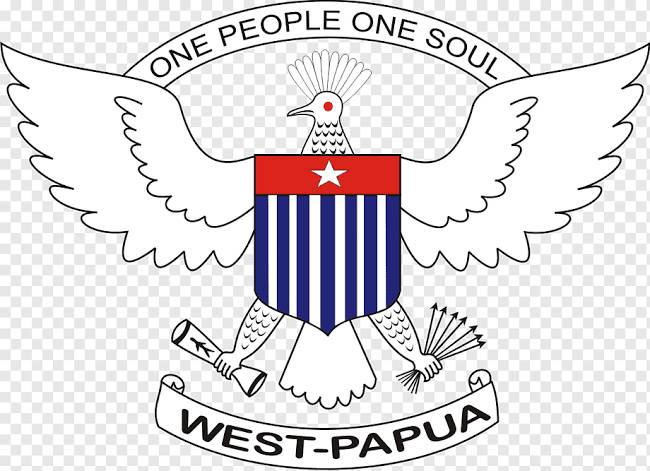
- The state emblem is the New Guinea Crown Pigeon.
- The anthem is Hai Tanah Ku Papua.
- The motto is “One People One Soul”.
- Other matters concerning symbols are further regulated in the statutory regulation.
PART XIII
LANGUAGE
Article 16
- The national language is Melanesian language consisting of the ethnic languages in West Papua.
- The unifying languages are Tok Pisin, English and Papuan Malay.
- Other matters concerning language are further regulated in the statutory regulation.
PART XIV
TERRITORY OF THE GOVERNMENT
Article 17
- The Provisional Government is based in West Papua.
- The Provisional Government’s headquarters is located in Port Vila, Republic of Vanuatu.
- The Provisional Government’s office in West Papua is located in Wamena.
- The Provisional Government’s territory consists of the Regional Government and the Local Government.
- The Regional Government territory is divided based on customary areas.
- The Regional Government is led by a Regional Chief Executive.
- The Local Government is led by the Local Chief Executive.
- The formation of the Regional Government and the Provisional Local Government is determined by Congress.
- The Chief Executive and the Local Chief Executive are appointed and dismissed by the Executive Council with the approval of the Legislative Council.
- The Provisional Government as stipulated in Article 6 applies at the regional and local levels.
- Other matters concerning the Government Territory are further regulated in the statutory regulation.
PART XV
DECISION MAKING
Article 18
- Decision-making mechanism consists of Congress, Conference and Meeting.
- Congress is the highest decision-making forum.
- Congress is declared valid when attended by two-thirds of Congress members
- The decision of the Congress is declared valid when it receives the support of two-thirds of the congress participants.
- Congressional decisions are reached through consensus and or voting.
- Conference consists of Special Session, Plenary Session, Annual Session.
- A meeting is declared valid when attended by two thirds of the meeting participants.
- The decision of the Conference is declared valid when it receives the support of two-thirds of the participants in the conference.
- The decisions of Conference are reached through consensus and or voting.
- The meetings are the Legislative Council Meeting, the Executive Council Meeting, the Judicial Council Meeting, the Constitutional Assembly Meeting, the Defense and Security Council Meeting and the Supreme Advisory Council Meeting.
- Meetings consist of coordination meetings and work meetings.
Congress, Session and Meeting procedures are further regulated in the statutory regulation.
PART XVI
BASIC RIGHTS
Article 19
Right to Life
- Every creature individually and collectives has the basic right to live in harmony.
- Every creature individually and collectively has the right to dignity and privileges.
- The Provisional Government recognizes and guarantees the right to life of every creature individually and collectively.
- Other matters concerning the Right to Life are further regulated in the statutory regulation.
Article 20
Right to Security
- Individuals and collectives have the right to be free from fear.
- Individuals and collectives have the right to security.
- Individuals and collectives have the right to live in peace, both physically and mentally.
- The Provisional Government guarantees and recognizes the right to security of individuals and collectives.
- Other matters concerning the Right to Security are further regulated in the statutory regulation.
Article 21
Right to Freedom
- Individuals and collectives have the right to freedom of assembly, association and expression.
- Individuals and collectives have the right to move and reside.
- The Provisional Government guarantees and recognizes the right to freedom of individuals and collectives.
- Other matters concerning the Right to Freedom are further regulated in the statutory regulation.
Article 22
Property Right
- Individuals and collectives have the right to ownership.
- The Provisional Government guarantees and recognizes the right to ownership of individuals and collectives.
- Other matters concerning Ownership Rights are further regulated in the statutory regulation.
Article 23
Social Right
- Individuals and collectives have the right to social security.
- Individuals have the right to form a household.
- Men and women have equal rights before the law.
- Other matters concerning Social Rights are further regulated in the statutory regulation.
Article 24
Political Right
- Individuals and collectives have political rights.
- The Provisional Government guarantees and recognizes political rights.
- Other matters concerning political rights are further regulated in the statutory regulation.
Article 25
Economic Right
- Individuals and collectives have the right to live a sufficient life.
- Individuals and collectives have the right to manage economic resources.
- The Provisional Government recognizes and guarantees the management of economic resources for a sufficient life.
- Other matters concerning Economic Rights are further regulated in the statutory regulation.
Article 26
Right to Health
- Individuals and collectives have the right to health.
- The Provisional Government guarantees and recognizes the right to health.
- Other matters concerning the Right to Health are further regulated in the statutory regulation.
Article 27
Rights to Education
- Individuals and collectives have the right to education and intellectuality.
- The Provisional Government guarantees and recognizes the right to education and intellectuality.
- Other matters concerning the Right to Education are further regulated in the statutory regulation.
Article 28
Cultural Rights
- Individuals and collectives have customary and cultural rights.
- The Provisional Government guarantees and recognizes customary and cultural rights.
- Customary and cultural rights cannot be mortgaged or misused.
- Other matters concerning Cultural Rights are further regulated in the statutory regulation.
Article 29
Rights to Healthy Environment
- Individuals and collectives have the right to a healthy environment.
- The Provisional Government guarantees and recognizes the right to a healthy environment.
- Individuals, collectives and the Provisional Government guarantee the environment as a source of life for planet earth.
- Other matters concerning Environmental Rights are further regulated in the statutory regulation.
Article 30
Rights of Belief and Religion
- Individuals and collectives have the right to belief and religion.
- The Provisional Government guarantees and recognizes the right to belief and religion.
- Other matters concerning the Right to Belief and Religion are further regulated in the statutory regulation.
Article 31
Rights to Land, Water and Air
- Individuals and collectives have rights to land, water and air.
- The Provisional Government guarantees and recognizes rights to land, water and air.
- Land, water and air are not for sale.
- Other matters concerning Land, Water and Air Rights are further regulated in the statutory regulation
Article 32
Awards, Medals and Heroes for Services
- Individuals and collectives have the right to awards, medals and heroes of the West Papua independence struggle.
- The Provisional Government guarantees and recognizes the right to awards and medals.
- Other matters concerning the Right to Medals are further regulated in the statutory regulation.
PART XVII
WEALTH
Article 33
- Wealth consists of natural resources, human resources and financial resources.
- The Provisional Government guarantees and recognizes the wealth of natural resources, human resources and financial resources.
- Wealth is used for the interests of the liberation struggle.
- Other matters concerning Wealth are further regulated in the statutory regulation.
Article 34
Natural Resources
- Natural resources consist of energy, minerals, animals and plants.
- The Provisional Government guarantees and recognizes natural resources.
- Other matters concerning Natural Resources are further regulated in the statutory regulation.
Article 35
Human Resources
- Human resources consist of services, skills, professionalism, expertise and intellectuality.
- The Provisional Government guarantees and recognizes human resources.
- Other matters concerning human resources are further regulated in the statutory regulation
Article 36
Financial Resources
- Financial resources consist of public donations, taxes, BEA, business results, donors, grants and loans.
- The Provisional Government guarantees and recognizes financial resources.
- The Executive Council has the authority to manage financial resources.
- Other matters concerning financial resources are further regulated in the statutory regulation.
PART XVIII
COOPERATION
Article 37
- The Provisional Government cooperates with government institutions and non-government institutions.
- The forms of government institution cooperation consist of bilateral, multilateral, sub-regional, regional, inter-regional, international and global.
- The forms of non-government cooperation consist of trade and investment cooperation, research and technology, culture and sports, religion and advocacy.
- Other matters concerning Cooperation are further regulated in the statutory regulation.
PART XIX
VIOLATIONS AND SANCTIONS
Article 38
- The Provisional Government is obliged to submit to and implement the provisions of the Constitution.
- Violations and deviations from the Constitution must be subject to sanctions.
- Violations and sanctions consist of actions that deviate from the Constitution.
- Sanctions are imposed on individuals and/or collectives.
- The Judicial Council has the authority to impose sanctions.
- Other matters concerning Violations and Sanctions are further regulated in the statutory regulation.
PART XX
AMMENDMENTS
Article 39
- Constitutional amendments are made in Congress and/or Extraordinary Congress.
- Constitutional amendments as stated in paragraph 1 above, are made by at least two-thirds of the members of Congress.
- Matters concerning the welfare of the people are subject to a public opinion poll.
- Other matters concerning Constitutional Amendments are further regulated in the statutory regulation.
PART XXI
TRANSITIONAL AND CLOSING ARRANGEMENTS
Article 40
Transitional Arrangements
- This Constitution is based on the Minutes of the First United Liberation Movement for West Papua Summit in Port Vila, Vanuatu, 27 November – 3 December 2017 on Amendment I to the Constitution of the United Liberation Movement for West Papua.
- This Constitution is based on the Minutes of the Extraordinary United Liberation Movement for West Papua Summit in Port Moresby, Papua New Guinea, 19 December 2019 on the Improvement of the Status of the United Liberation Movement for West Papua Management.
- This Constitution is based on the Minutes of the Third Annual Session of the United Liberation Movement for West Papua Legislative Committee in Port Numbay, West Papua, 18 October 2020 on the Improvement of the Organizational Status with the Establishment of a Provisional Constitution.
- For the first time, the President and Prime Minister were appointed by the Third Annual Session of the United Liberation Movement for West Papua Legislative Committee.
- Before the formation of the cabinet, institutions and other government bodies based on this Constitution, all powers are exercised by the President together with the Prime Minister and assisted by the organizational apparatus of the United Liberation Movement for West Papua.
Closing Arrangements
- This constitution was established and ratified by the Extraordinary Summit of the United Liberation Movement for West Papua.
- This constitution shall come into force from the date of its establishment until the end of the transition period.
Ditetapkan di: Port Numbay, West Papua
On Date: 28 November 2020
On Time: At 1:20AM
ssss
| THE COMMITTEE OF THE EXTRA-ORDINARY SUMMIT OF THE UNITED LIBERATION MOVEMENT FOR WEST PAPUA | ||
| Edison Waromi, S.H | Jonah Wenda | Buchtar Tabuni |
| CHAIR | CHAIR I | CHAIR II |
PS:
- Please read the Original/ Malay Version of the Constitution here
- ULMWP Website https://ulmwp.org
- West Papua Country Website https://westpapua.country
- Green State Vision Website https://greenstatevision.info
- West Papua Army Website https://wpa.news.blog and https://westpapuaarmy.com
 UUDS ULMWP